Mike Sweetney (2000-2003)
|
ALL-AMERICA, 2003
|
|
GEORGETOWN ATHLETIC HALL OF FAME
|
A dominating power forward over his three years at the Hilltop, Mike Sweetney carried the Georgetown Hoyas on his shoulders during his final two seasons, establishing his legacy amidst some difficult years for the Blue and Gray.
Sweetney came to Georgetown in 2000 as a Top 50 selection from Oxon Hill, MD, having committed two seasons earlier. Despite averaging 25 points and 13 rebounds for the Clippers, there were recruiting experts who sold him short, considering him a step slow to consistently compete in the Big East. Sweetney got into shape by his freshman season and was an immediate impact on a Georgetown team which began the 2000-01 season 16-0, its best start in 16 seasons. He scored 19 points in each of his first three games, and by season's end had led the team in scoring 11 times and rebounds in 13 games. Sweetney quickly became the Hoyas' best power forward since Jerome Williams (1994-96), but while Williams was primarily a rebounder, Sweetney could also score down low and muscle his way for a number of offensive rebounds and putbacks.
It was during the 2001 Big East season that Sweetney began to ring up some big numbers in points and rebounds. A 14 point, 14 rebound effort paced the Hoyas past #18 Seton Hall, a double-double a week later versus UNLV, and a 14 and 13 effort against Syracuse. Posting a season high 24 points against Pitt and a 10.0 rebound average in the NCAA tournament, Sweetney was named to the Big East All-Rookie team, averaging 12.8 points and 7.4 rebounds a game.
Sweetney proved dominant as a sophomore but he could not do it alone. If the outside shooting failed (which it did) or the defense was lacking (which it could), even a mighty effort might not be enough. In January, 2002, Sweetney manhandled Rutgers for 26 points and 13 rebounds, but the Hoyas lost composure in overtime and lost by two, 89-87. His 35 points and 20 rebounds were the story of an amazing four overtime game with Notre Dame, but when Sweetney fouled out late in the 4th overtime, the Hoyas imploded, 115-111. He posted a 31 point effort at Villanova, but while Sweetney was 11 for 15 (.734), the rest of the team shot 11 for 57 (.192), 2 of 16 in overtime, and the Hoyas lost by eleven, 83-72. Sweetney finished the season averaging 19 points and 10 rebounds, and was named to the first team All-Big East roster.
For his junior season, Sweetney literally carried the team. He led the team in scoring 25 times, never scoring below double figures. He led the team in rebounding 29 times, with 16 double figure rebound efforts. Shooting 55 percent from the floor and 74 percent from the line, he accounted for nearly a third of the team's offense that season. Sweetney opened Big East play with 35 points and 19 rebounds in an overtime win versus West Virginia and never let up. His 25.1 per game average trails only Allen Iverson for a single season average, with sterling efforts against Notre Dame (38 points, 15 rebounds), at Syracuse (32 points, 13 rebounds), Pitt (28 points, 8 rebounds), and home versus Syracuse (31 points, 19 rebounds).
At season's end, Sweetney had led the Hoyas to the brink of the NIT championship, leading the team in scoring in his final seven games and 13 of its last 15. Sweetney's season was nothing short of remarkable, even if the nation's press downplayed his accomplishments and offered only honorable mention All-America status. His 776 points in a season was third most in school history, and was only the eighth player in Georgetown history to lead his team in scoring three consecutive seasons, and the first to do so since Patrick Ewing (1982-85).
In the off-season, head coach Craig Esherick discussed opportunities for Sweetney in the NBA, and Sweetney opted for the draft in June 2003, becoming only the third early entry in school history. Sweetney was selected by the New York Knicks with the ninth pick of the 2003 draft, but weight issues forced him out of the NBA four years later.
But this was only part of the story.
Shortly before reporting to NBA training camp in 2003, Michael's father died of a sudden heart attack. The loss of his father sent Sweetney into severe depression through his NBA career, but absent a diagnosis it was easier for coaches or the media to say he was unmotivated or, in the case of his weight gain, that he was too fat for the pros.
"I didn't like basketball and I just didn't like life at the time," he told Hoopshype in a 2017 interview. "I went from being a star at Georgetown and having my father at every game, to losing him and not even playing in the NBA. I knew I wasn't going to be given a chance as a rookie because my coach told me, hey, I'm not going to play you. I had a lot of things going on that were rough for me to handle. I had dug myself into a really deep depression and, at that point, I was really scared to tell anybody... Even after I tried to commit suicide, nobody really knew. I was suffering really bad. I was in New York, battling this while the media was writing articles about me, and I felt like I had nowhere to go. I just kept digging myself into a deeper hole of depression."
At nearly 400 pounds upon his release in 2007, Sweetney lived out of a car for months on end, embarrassed to go home to his family.
"I had moved out of my house, left my family and I was sleeping in parks or cars," Sweetney said. "I felt like a failure. I just didn't want to be around anybody and I felt terrible. Then, in 2009, that's when I got to a point where things started heading in a better direction. I knew I had to pull myself out of that and get myself together. It took some time, but my family and friends had my back and helped me get through those really tough times."
Sweetney played 10 years in the South American leagues, and began to speak out on the issues of mental health among athletes. He also reconnected with a former high school friend, Tamir Goodman, who with Sweetney was co-MVP of the 2000 Capital Classic. Goodman, whose college career did not take off as planned, was nonetheless a legendary figure in Israel. Goodman was looking for volunteers to help with a skills camp he was scheduling in Israel and Sweetney volunteered. The warmth of the Israeli community touched Sweetney, and he returned the following year as well. A call from Goodman put Sweetney in touch with Division III head coach Elliot Steinmetz, who was interviewing candidates for an assistant's role at Yeshiva University.
Sweetney served as an assistant coach at Yeshiva from 2019-23, which included a 50-0 streak for the Maccabees from 2019 through 2021. Sweetney also served as the head women's basketball coach at the Ramaz School on the Upper East Side of Manhattan. A month before his death in September 2026, he was announced as the new men's basketball coach at Golda Och Academy, a private boys school in West Orange, NJ.
One can imagine what Mike Sweetney's professional career would have been like with a couple of breaks here and there. One doesn't have to imagine what Georgetown basketball of these years would have been like without him, however. The 2003-04 season was evidence enough.
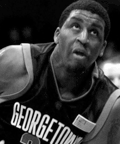
MICHAEL D. SWEETNEY
Born: Oct. 25, 1982
Died: September 17, 2026
Hometown: Oxon Hill, MD
High School: Oxon Hill
Position: Forward
Height: 6-8
Weight: 270
Years on Team: 2000-03
| Season | GP | GS | Min | FG | FGA | % | 3FG | 3GA | % | FT | FTA | % | Off | Reb | Avg | PF | Ast | Blk | Stl | Pts | Avg |
|---|---|---|---|---|---|---|---|---|---|---|---|---|---|---|---|---|---|---|---|---|---|
| 2000-01 | 33 | 33 | 798 | 159 | 308 | 51.6 | 0 | 0 | 0.0 | 104 | 168 | 61.9 | 109 | 245 | 7.4 | 67 | 59 | 23 | 26 | 422 | 12.8 |
| 2001-02 | 29 | 28 | 883 | 185 | 326 | 56.7 | 0 | 1 | 0.0 | 182 | 231 | 78.8 | 103 | 290 | 10.0 | 62 | 49 | 48 | 25 | 552 | 19.0 |
| 2002-03 | 34 | 34 | 1100 | 264 | 483 | 54.7 | 0 | 3 | 0.0 | 248 | 336 | 73.8 | 137 | 352 | 10.4 | 95 | 66 | 109 | 50 | 776 | 22.8 |
| Totals | 96 | 95 | 2781 | 607 | 1117 | 54.3 | 0 | 4 | 0.0 | 534 | 735 | 72.6 | 349 | 887 | 9.2 | 224 | 174 | 180 | 101 | 1750 | 18.2 |